
Boarded the Rajdhani (“The Capital”) Express to Delhi from Ernakulam Junction at 10 30 pm on August 28, 2015. The fully air conditioned superfast train to Hazrat Nizamuddin was one of the 22 pairs of trains connecting the national capital New Delhi to the various state capitals and the Thiruvananthapuram Rajdhani ran the longest distance covering 3149 kilometers. Complementary morning tea, breakfast, lunch, high tea and dinner was part of the reservation package.
In the train, I occupied a lower berth and a window seat and found that my travel companions were a Malayali family settled in Mumbai returning after a short visit to their hometown for the Onam family get together; a gentleman working with the Ministry of Agriculture in New Delhi, returning after attending a function at home; a mother and child travelling upto Kannur whose place was later taken up at Uduppi by a senior gentleman, also travelling back to his son in New Delhi after a family function at his home town. A young man from the Hindi heartland, who was part of a group in the compartment, appeared only to sleep.
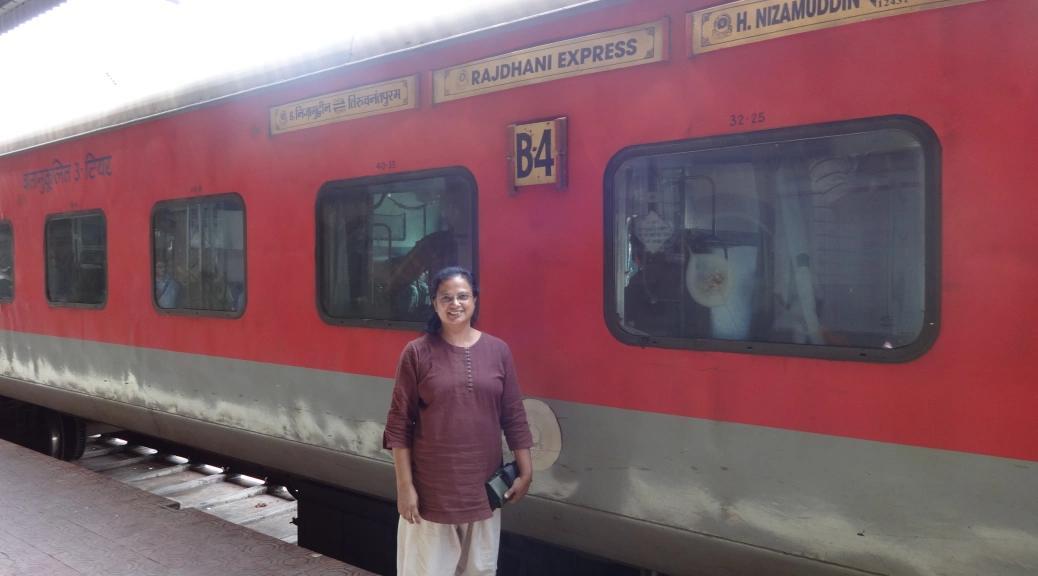
I was provided with a bottle of water, a pillow, a blanket, and a brown paper packet which contained a cotton bed sheet, a soft woollen sheet and a face towel. Cosy and warm I settled down to sleep in half an hour and by the time I woke up at 5.30 am I had crossed the state through Trichur, Shornur, Kozhikode and Kannur, to arrive at Mangalore to savour the morning tea and a mangaluru edition of the Hindu newspaper.
After a stop at Udupi, by 8.30 breakfast arrived for which I had opted a bread omelette. Hot water in a thermos flask, sugar, dairy whitener and tea bags were brought in too. Sipping hot tea I watched lush green fields and hills pass by, fresh and wet after the rains when suddenly the train tunnelled through darkness in the mountains. Protective netting on the tunnel walls prevented boulders from rolling on to the tracks.
The Konkan Railway commissioned in 1998 linking Maharashtra, Goa and Karnataka, ran parallel to the Arabian Sea coastline boring through the Sahyadri Ranges/the Western Ghats. Long bridges connected hills and crossed turbulent rivers. The railway line had around 2000 bridges and 91 tunnels between Mumbai and Mangaluru, the two important port cities it linked.
The automatic announcing system informed that soon we would be arriving at Karwar, a port town at the mouth of Kali river in uttara kannada. When the train stopped at Mudgaon station for 10 minutes, a number of people got down. Soon we were moving forward through small fishing villages, through Verna, Carmali, Madure. . .
Around 12.30 somewhere between Mudgaon and Sawantwadi Road bread sticks and butter was served with piping hot tomato soup as an appetiser for the lunch to follow. The announcement told of the approach to Sawantwadi Road. At the station I noticed a RORO (Roll on/ Roll off) train. This piggyback transportation system got fully loaded road trucks onto railway flatcars creating a rolling highway between Kolad in Maharashtra and Suratkal in Karnataka. Lunch served after leaving Sawatwadi Road consisted of roti and dal, rice and chicken curry as I had chosen non-veg meals, curd and gulab jamun as dessert. Onward through Sawde and Chiplun. . .
The compartment fell asleep after lunch only to be woken up by the snack tray of bread sandwich, hot samosa and tea. Ratnagiri had passed by unnoticed. Refreshed I noticed that not a stretch of dry barren land was to be seen so far. The whole area of visible earth seemed to be rich and verdant, covered by a thick green blanket, tall trees dripping wet, small rivulets and mist covered mountains telling of the recent rains, – hills and valleys and quiet villages . . . concrete jungles didn’t exist. But frequent travellers had seen the face of the land turned brown, parched and dry in summer.
The family got down at Panvel and the cubicle suddenly fell silent.
Rasam, was served an hour before dinner which was vegetarian by choice – Roti and veg curry, rice and paneer, curd and sweet. Curling up in no time to sleep again.
30 August. Morning tea with Marie biscuits as the train glided past Ratlam station where the passengers from the Mumbai – Amritsar Golden Temple train were stretching their legs on the platform. The hills had disappeared to give way to flat lands. The crops had changed, the trees were different, the soil colour had changed. Instead of tall trees there were short spikey ones, and the fields sported fertile black soil. Electric towers and wind breaker trees dotted the landscape.
Soon I passed Kharchood; I could see a lake near Berawanya and before Nagda, water dammed up for irrigation- Thuria was followed by a river bridge and then yet another one. Nimbu paani was served at 8 am. Suwaba sported slate slab fences, and its grazing cattle. A shepherd with a pole on his shoulders and arms wound around the pole led his flock of sheep – a long line following like disciplined school children in rows of two. After Morak, crossing Amar Nala, hills came into view again, which changed into rocky plains near Dara where cattle and sheep pulled at vegetation growing flat and close to the ground. Lone figures walking across the open space; possible destination, – invisible to the traveller’s eye. At Rawda road, the piled up containers readied for shipping spoke of a thriving trade.
The railway line seemed to divide the land into two areas with seemingly uninhabited flat land on one side and industry and flat roofed housing on the other. Dhanikashar? . . . career point university. . . alniya river, to the rail track hewn through rock – Oriental Power cables at Alniya with herons resting on the tree top behind the station. The train which is known to reach a speed of upto 140 km/hr. passed stations in quick succession. More grey rocks and white birds- and suddenly you come upon the suburbs of an industrial area marked by its housing estate and “river” of industrial effluence- it is Dakaniya Talav, kota. The train reaches Kota Jn at 10.15, 20 min before time. The half an hour stop emboldens me to step on to the platform and take a look around. Part of the West Central railway it had an entrance with paintings of Rajastani murals. I got a newspaper from the lone bookstall for Rs. 4 – the Jaipur edition of Sunday Times, – took a couple of pictures and got back on board. The news highlighted the Sheena Bora murder case, Rajastan Teachers Association rally, a page was dedicated to Hindi films which featured Indo Pakistan relationships as theme, Shobha De’s message to Prime Minister Narendra Modi on the eve of Rakshabandhan day reminded him of bold promises remaining unfulfilled. Another article claimed that Arya bhatta, the mathematician astronomer had mentioned gravity in his Siddhant Shiromani much before Newton and that Varamihir in his Vrihat Samita had enlisted the signs of the earth quake, and that this knowledge was preserved for posterity in the Sanskrit language. There was also another one which stressed on the need to promote Sanskrit, described as the dev vani, and vigyan vani to a jan vani.
During the whole distance the train had only 19 scheduled stops and a total of 90 min breaks. Most of the delay came from crossings and yet it managed to reach quite a few stations before time. Passing Chambal River reminded me of Phulan devi and her gang and the dangers that lurked there in earlier times for train passengers. More green fields take us through Kapren, hills again at Amli, Mokholi, Malarna, Narayanpur, Gambhir, and lunch of plain rice and dal arrives to keep us busy. After lunch I saw Bharatpur Jn. Whizzing past.
The ‘other’ India of the Slum dog Millionaire came into view as the train passed through Firozabad, and Tuglakabad before arriving at Hazrat Nizamuddin 15 min before time.